
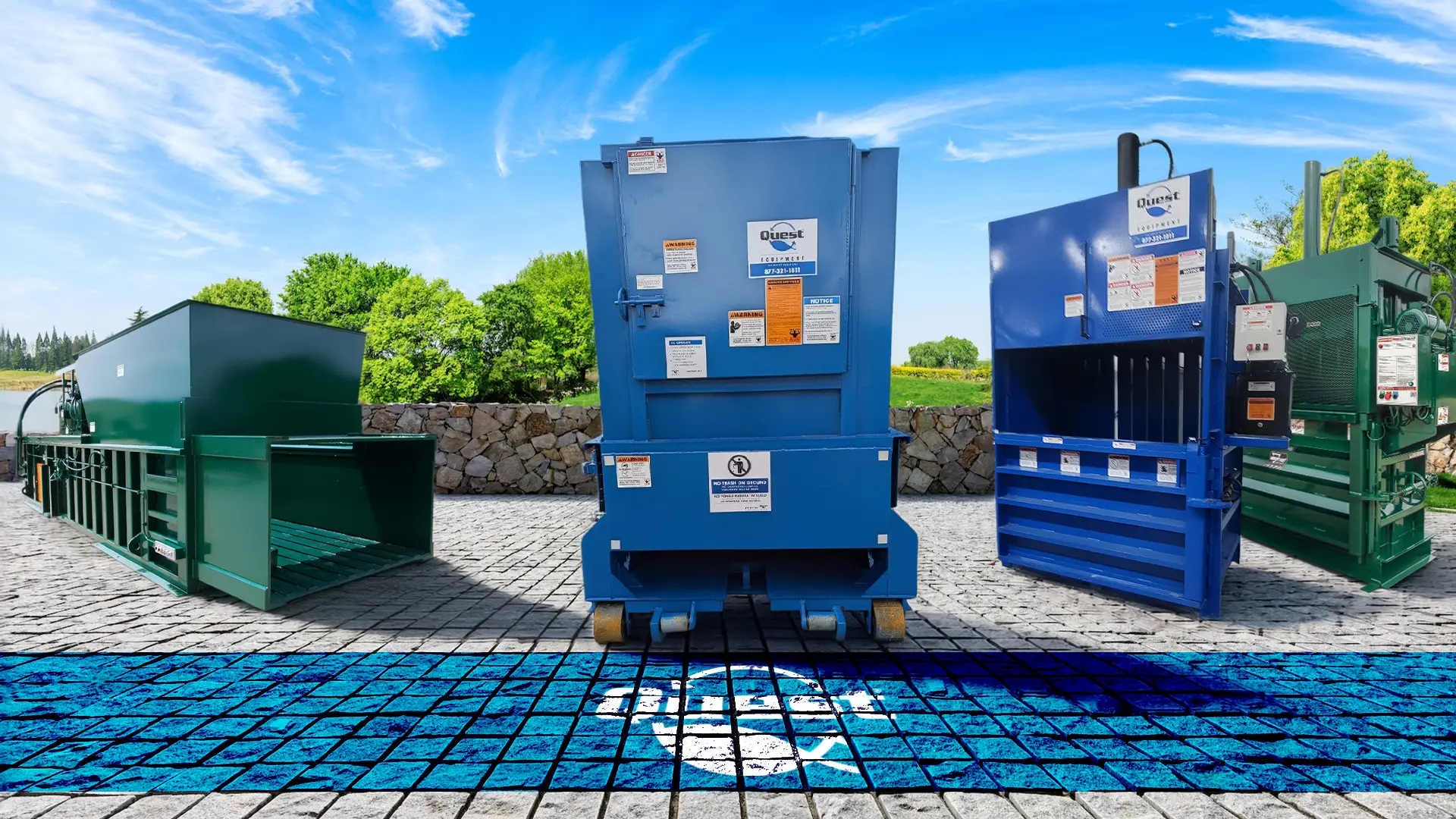
For most multi-location operators, equipment is an afterthought. Containers arrive, haulers show up, and the system seems to work until it doesn’t. Overage charges appear on every invoice. Trucks return for pickups that could have been avoided, or haul away containers that are only half full. A location falls short of a recycling requirement, or a back lot becomes an eyesore that customers notice.
These problems rarely come from a single bad decision. They come from equipment and service schedules that were never matched to the site, the material, or the way the team actually works.
At Quest, our equipment solutions experts know that the right equipment benefits nearly every commercial operation. The key is knowing what to look for.
Right-Sizing: Where the Savings Begin
Right-sizing means matching your equipment to your true volume and material type. When it’s done well, the results show up quickly on your bottom line.
Consider a common scenario. A site runs three 8-yard front-load containers, serviced five days a week. Even with that schedule, the containers are full and material spills over the lids. Each time that happens, the hauler adds an overage charge. Monthly service costs climb, and the problem never truly goes away.
Compaction changes that. By compressing material on-site, a properly sized compactor can:
- Reduce hauler pickups, since each haul carries far more material
- Eliminate overage charges from overflowing containers
- Limit heavy truck traffic that wears down pavement, asphalt, and grounds
- Improve onsite safety by reducing vehicle movement around people
- Contain odors and deter pests with an enclosed, sealed system
- Improve site appearance for customers, tenants, and employees
Fewer trucks on your property is a benefit many operators overlook. Every commercial front-load truck that enters your lot adds wear and tear. For clients who care about their property’s condition, reducing that traffic is a meaningful gain.
Navigating Franchise Markets
In many cities, operators work within a closed or “franchise” market. In these areas, the municipality contracts with a single hauler, and businesses cannot choose their own provider.
That limitation does not extend to equipment. While you may not control who hauls your material, you can own your own equipment. This matters because the franchise hauler may not offer the equipment you need, or it may charge a premium for it. Owning your equipment gives you more control over cost, quality, and performance, even in a market with limited choices.
Owned equipment also gives you the flexibility to add electronic monitoring and access controls that a franchise hauler may not provide.
Equipment Solutions Across Every Vertical
Equipment strategy applies to every commercial setting. Quest supports operators across a wide range of industries, including:
- Quick-service restaurants
- Automotive
- Big-box retail
- Grocery
- Hospitality
- Multi-family housing
- Industrial and manufacturing
- Distribution centers
Each vertical has unique needs. Quick-service restaurants, for example, often have high volumes but very little space. Many operators assume compactors are too large for their footprint. In reality, smaller models fit tight lots, and some locations can use units designed specifically for commercial interior kitchens.
Industrial facilities face a different challenge. Many run around the clock across multiple shifts. They cannot afford a lapse in service, because if disposal stops, the production line stops. Compactors provide the capacity and reliability these operations require.

Specialized Equipment for Unique Challenges
The right solution often depends on equipment that many operators don’t know exists. Quest helps clients identify and deploy options such as:
- Interior kitchen compactors for restaurants without outdoor space
- Self-contained compactors built for wet or liquid material, such as high-volume food waste
- Pre-crushers for bulky items like crates, fixtures, and pallets
- Augers for dense loads of pallets and cardboard
- Balers for cardboard and plastics
- Shared service compactors for mixed-use centers and multi-tenant properties
Balers deserve special attention. When cardboard and plastics go loose into front-load or open-top containers, they get commingled with trash. Even if that material reaches a recycling center, you earn nothing for it. Baling keeps commodities clean and separated, which allows you to earn rebates on material you once paid to haul away.
Pre-crushers, augers and even shredders also support product destruction and brand compliance. Some brands cannot allow their products to be seen intact at a landfill. Crushing or shredding the material on-site protects brand reputation before it leaves the property.
Shared service compactors offer a clear advantage for landlords and property managers. Instead of dozens of individual tenant dumpsters, all tenants feed one compactor. This keeps standards uniform, prevents missed pickups when a single tenant falls behind on payments, and presents a cleaner property to shoppers and visitors.
Common Equipment Mistakes to Avoid
The most frequent mistake is selecting equipment before mapping the property layout. In our experience, while volume and material type determine the basic size or model of a compactor, the remaining details depend entirely on the site. Before choosing equipment, operators should answer key questions:
- Will the unit sit at a loading dock, or will it be ground-fed or chute-fed?
- Does it need a door, gate, platform, or rails?
- Is a full enclosure required for weather, after-hours use, or employee safety?
- Is there a concrete pad and dedicated electrical service?
Skipping these due diligence steps leads to equipment that is difficult to use or poorly suited to the location. How a compactor is loaded is critical. On-site teams need it to be simple, safe, and accessible in rain, snow, or darkness. Some national brands require full enclosures in certain regions, so employees never have to step outside into unsafe areas.
The Ice Cream Shop Analogy
Think of it like ordering at an ice cream shop. A customer asks for ice cream, and the next questions follow naturally. What flavor? Cup or cone? Sprinkles or chocolate chips?
Equipment works the same way. Every choice, from loading method to enclosure design, shapes the final solution. Each detail becomes part of a permanent system that either supports long-term success or creates daily frustration. Ordering a compactor is not as simple as requesting a dumpster, and that nuance is exactly why expert guidance matters.
Quest can even join the design process early. For new builds and redesigns, our team works with architects before construction is complete, providing compactor specifications so enclosures are built to fit from day one.
Training That Sets Your Team Up for Success
Installation is only the beginning. After every deployment, Quest conducts on-site training with staff. Even when operation seems as simple as pressing a button, dedicated training builds confidence and ensures safe, consistent use. For larger systems, training may span multiple days or cover several shifts, so every team member is prepared.
What Multi-Unit Operators Gain
A thoughtful equipment strategy delivers lasting value across your entire portfolio:
- Predictable costs with fewer overages and optimized service schedules
- Fewer vendors to manage through a single, accountable partner
- Consistent brand standards at every location
- New revenue opportunities through commodity rebates
- Stronger diversion and recycling programs that support sustainability goals
Your Partner in Equipment Strategy
Quest serves as your expert partner from first assessment to final training. Our team designs, right-sizes, sources, deploys, and supports equipment solutions across hundreds of locations. Every site is unique, and we tailor each solution to its material, layout, and operational needs.
The right equipment reduces costs, simplifies operations, and protects your brand at every location. Let our experts show you what’s possible.
Contact us today to get the right equipment for your location and take the first step toward smarter, more efficient environmental services.